
November 11, 2025 — Keokuk, Iowa
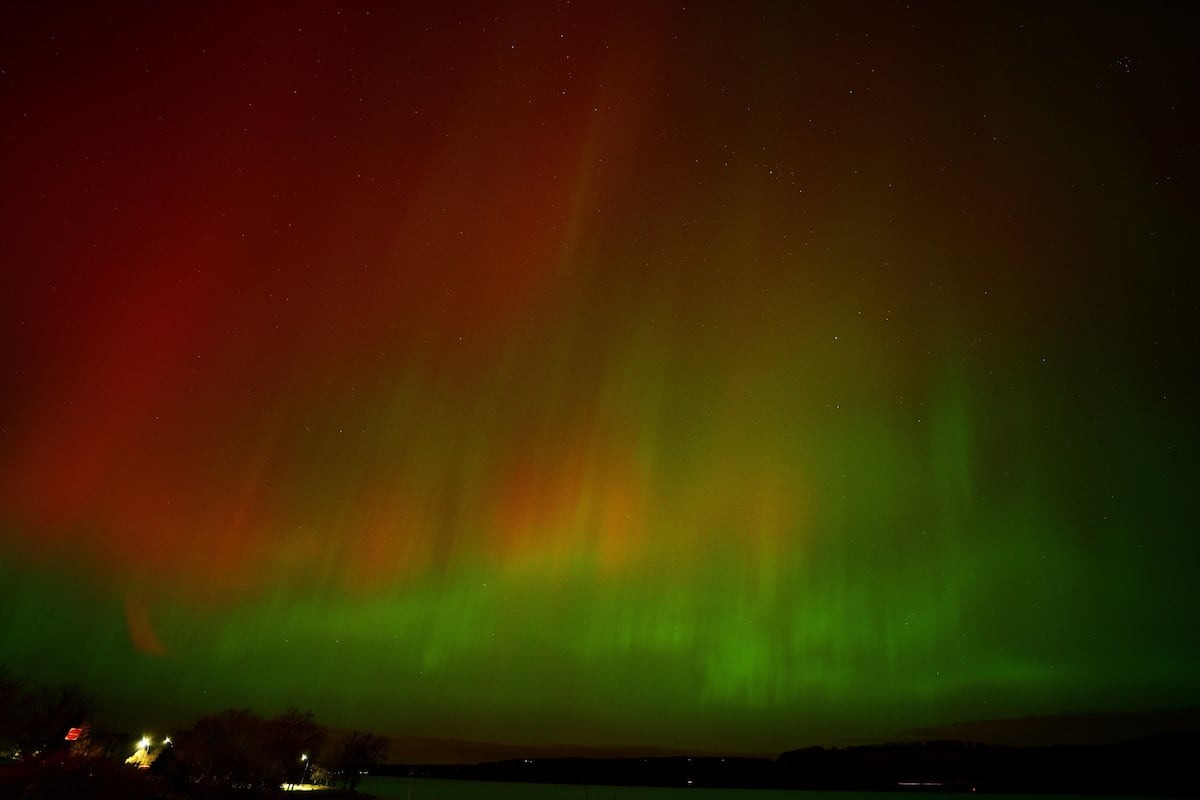
That night, the sky in Keokuk didn’t look extraordinary at first glance. Standing in the cool November air, I saw a faint glow to the north — almost like a trick of the light, a soft haze against the dark. To the naked eye, it could’ve been mistaken for distant city glow. But through my camera lens, the truth unfolded: the northern lights had come to Iowa.
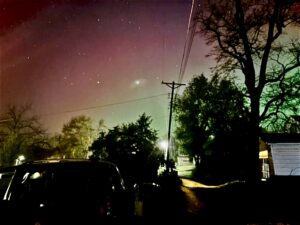
The resulting image — streaks of green and red shimmering beyond the trees — captured something our eyes couldn’t fully see. Cameras can pick up colors and wavelengths that escape human vision in low light, and that’s exactly what happened here. What looked like a dimly lit horizon to us was actually the aurora borealis, pushed far south by a powerful geomagnetic storm.
The Solar Storm That Brought the Aurora South
Earlier that day, an X-class solar flare — one of the most energetic types — erupted from a sunspot cluster known as Active Region 4274. The flare launched a massive coronal mass ejection (CME) — a burst of magnetized plasma traveling through space at over 1,500 km/s.
When it collided with Earth’s magnetic field, it triggered a G4 (Severe) geomagnetic storm, according to NOAA’s Space Weather Prediction Center. For context, geomagnetic storms are rated from G1 (Minor) to G5 (Extreme) — so a G4 is among the most powerful Earth can experience without causing major disruptions.
These storms distort the planet’s magnetic field, causing charged particles to flow into the atmosphere, where they collide with oxygen and nitrogen atoms. Those collisions release light — the aurora — painting the sky in greens, reds, and purples.
This particular storm expanded the auroral oval much farther south than usual. While auroras typically favor northern latitudes like Canada or Scandinavia, this event made them visible deep into the Midwestern United States — as far south as Texas, Missouri, and Iowa.
The Science Behind the Color
The colors of the aurora depend on altitude and atmospheric chemistry:
- Green: Oxygen about 60–90 miles high; the most common color.
- Red: Oxygen at 150 miles or more; visible during strong storms.
- Purple or Pink: Nitrogen molecules reacting at lower altitudes.
In my Keokuk photo, you can see both green and a faint red tint — a rare combination that only occurs when energy from the Sun is strong enough to excite atoms in both atmospheric layers.
Our human eyes struggle to pick up these hues in real time, but smartphone and DSLR sensors, with longer exposure times, make them glow vividly — revealing what’s otherwise hidden.
A Night to Remember in Keokuk
Seeing an aurora this far south is an experience few Midwesterners ever get. Keokuk sits near 40° N latitude, hundreds of miles below the usual auroral boundary. That’s what makes this photograph so meaningful — it’s both a local memory and a cosmic event captured in one frame.
On the ground, it was a calm night. Overhead, space weather was raging — the Sun’s magnetic power reaching across millions of miles to touch the skies above our quiet river town.
Aurora Science 101
| Term | Meaning |
|---|---|
| CME (Coronal Mass Ejection) | A massive eruption of charged particles and magnetic fields from the Sun. |
| Geomagnetic Storm | A disturbance in Earth’s magnetic field caused by CMEs or solar winds. |
| G4 (Severe) | NOAA’s fourth-highest storm level, capable of driving auroras to mid-latitudes. |
| Auroral Oval | The ring around Earth’s poles where auroras usually occur — expands southward during storms. |
Final Thoughts
What amazes me most is how a camera can make the invisible visible. Standing there in Keokuk, the sky didn’t seem particularly unusual — but a single long-exposure shot revealed a dance of light shaped by forces beyond Earth.
It’s a reminder that beauty doesn’t always announce itself. Sometimes it hides just beyond the limits of our eyes — waiting for the right lens, the right moment, and a little curiosity to bring it to life.


